Species collections / Psittaculidae / Subfamily Psittaculinae
Singing Parrot
Geoffroyus heteroclitus (Hombron & Jacquinot, 1841)
Tribe Psittaculini · Subfamily Psittaculinae · Family Psittaculidae (Old World parrots)
Photo gallery ↓ · Avicultural knowledge ↓ · Names & Taxonomy · Read the 1998 article in The S.S. Squawks a Lot
Photo gallery
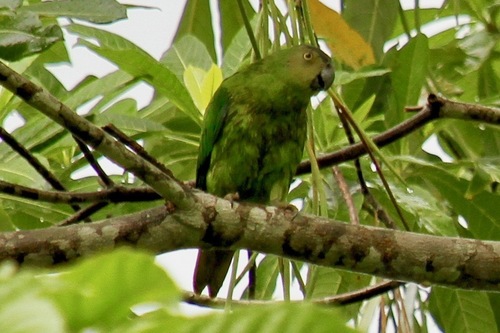
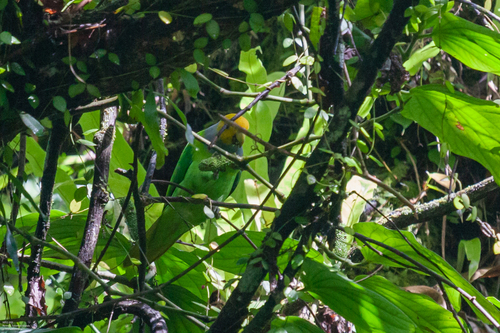
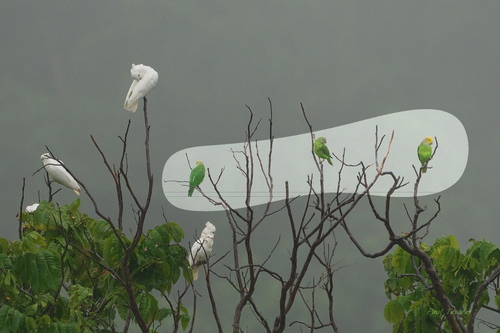
12 Creative Commons–licensed photos of Geoffroyus heteroclitus from iNaturalist observers. Every photo is from a wild bird whose identification has been confirmed by the iNaturalist community. Age and sex are shown only where the observation records them. Photos remain the copyright of their photographers and are shown, resized but otherwise unedited, under the licence named with each one for non-commercial educational use. Select a photo to open its observation.

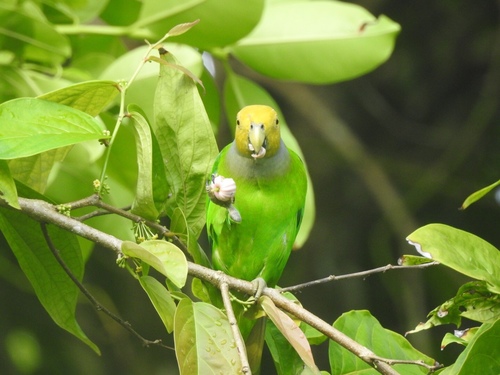
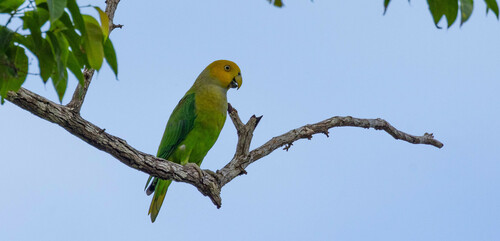
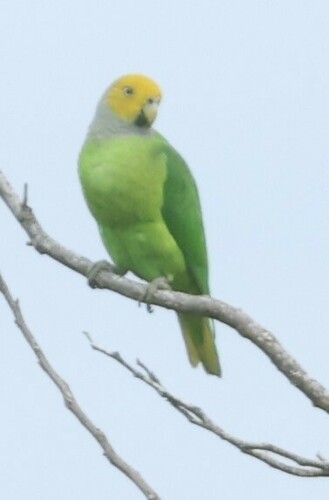
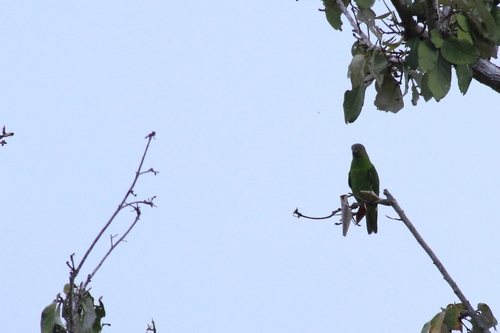
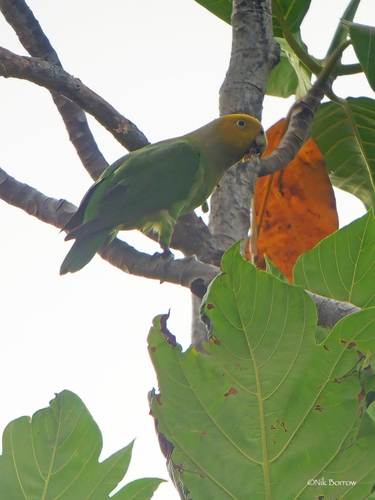
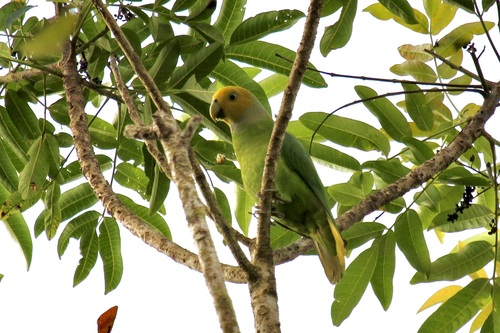
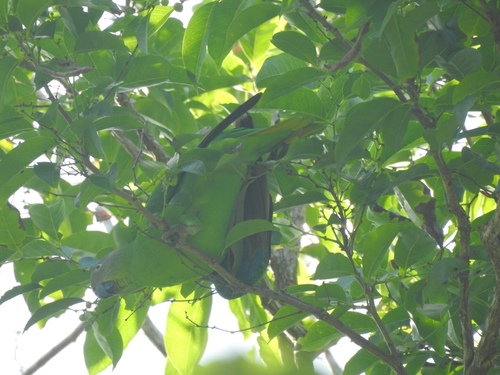
More photos: eBird / Macaulay Library · iNaturalist . eBird photos stay at their publisher because they are not licensed for reuse here.
Natural history
A medium-sized, stocky parrot with a short, almost square tail, about 25 cm long (Low, Thom and Thom (1998)).
The sexes look different. The adult male has a yellow head and a soft blue-mauve collar; the female’s head is a soft blue-tinged brown. Both have a whitish-yellow iris, and the blue underwing coverts show only in flight (Low, Thom and Thom (1998)).
It lives in subtropical and tropical moist lowland forest (IUCN Red List ).
As its name suggests, it sings. In the aviaries described by Low, the birds sang for up to half an hour at a time, and always before mating (Low, Thom and Thom (1998)).
Geographic range
Resident in the Bismarck Archipelago of Papua New Guinea (except the Admiralty Islands and St Matthias Islands) and east through the Solomon Islands. Birds on Rennell Island in the southern Solomons belong to a separate subspecies (Birds of the World ).
Sounds & Vocalizations
Listen to recordings in the Macaulay Library.
Cornell Lab of Ornithology, Macaulay Library. Birds of the World listed 31 recordings of this species when checked on 27 November 2026.
Avicultural knowledge
| Measure | Record | Source |
|---|---|---|
| Eggs per clutch | 2 usual; 1 once (infertile, January 1997) | Low, Thom & Thom (1998), p. 34 |
| Clutches per season | One hen laid five clutches between July 1996 and August 1997, three of them in 1997 (January, March–April, August) | Low, Thom & Thom (1998), p. 33–34 |
| Laying interval | 2–3 days between eggs | Low, Thom & Thom (1998), p. 34 |
| Incubation period | 25–26 days | Low, Thom & Thom (1998), p. 34 |
| Egg size | Not recorded | — |
| Weight at hatching | Not recorded | — |
| Eyes open | About 11 days | Low, Thom & Thom (1998), p. 34 |
| First perching | 42 days (one chick) | Low, Thom & Thom (1998), p. 34 |
| Peak chick weight | 141 g at 43 days, falling to 126 g by about 55 days | Low, Thom & Thom (1998), p. 34 |
| Days to fledge (first flight) | 58 days | Low, Thom & Thom (1998), p. 34 |
| Adult weight | Males 116–135 g; females 146–172 g | Low, Thom & Thom (1998), p. 33 |
| Adult length | About 25 cm | Low, Thom & Thom (1998), p. 33 |
| Nest-box entrance | 70 mm wide × 90 mm high | Low, Thom & Thom (1998), p. 33 |
| Sexual maturity | One male was mature six months after his beak began to lighten | Low, Thom & Thom (1998), p. 34 |
Almost all published avicultural information on this species comes from a single 1998 account of a small group kept by Mike and Terry Thom in South Africa, which records what was probably the first, and to our knowledge the only, captive breeding. It is summarized here; Low, Thom and Thom (1998) is available in full in The S.S. Squawks a Lot.
Many birds in a 1994–1995 import died. The underlying cause was dehydration. The birds chew bananas, including the skin, swallow the juice and reject nearly all the solids. They rarely drink from a dish, so juicy fruit or vegetables every day were the key to keeping them.
The hen’s first egg, in August 1996, contained an embryo that died. Her October clutch hatched, but both chicks died at ten weeks during hand-rearing, probably from a contaminated jar of puréed pumpkin. The pair went on breeding through 1997. The male did not enter the nest during incubation; he began feeding the hen the day after the chicks hatched, favouring mulberries, green beans, carrot tops and sprouted sunflower seed.
The beak of the young changes colour with age: yellowish at hatching, dark grey by seven weeks, lightening from eight weeks, and pale on both mandibles by four months. Young males moult into adult head plumage gradually. In this group the females were heavier than the males.
These are observations of one small captive group, not a care guide. For advice about an individual bird’s health or care, consult an avian veterinarian.
Conservation status
- IUCN category
- Least Concern
- Assessment
- BirdLife International, 2018 · IUCN Red List species page
- Date checked
- 27 November 2026
- CITES
- Appendix II (as part of the listing for all parrots, Psittaciformes, not otherwise listed)
BirdLife International calls this species the Song Parrot (BirdLife DataZone factsheet ).
Names & taxonomy
Taxonomic rank: Species. Accepted at species rank in eBird/Clements v2026 as Geoffroyus heteroclitus, Singing Parrot, family Psittaculidae. Matched in Cornell’s versioned eBird taxonomy API on 27 November 2026. View the versioned taxonomy match .
- Scientific name
- Geoffroyus heteroclitus (Hombron & Jacquinot, 1841)
- Also known as
- Song Parrot
- Original description
- Psittacus Geoffroyi heteroclitus Hombron & Jacquinot, 1841, Annales des Sciences Naturelles, Zoologie, ser. 2, 16: 319. Type locality San Jorge and Ysabel Islands, Solomon Islands. (Source: Birds of the World, citing Avibase; checked 27 November 2026.)
- Group
- Subfamily Psittaculinae (tribe Psittaculini)
- Family
- Psittaculidae (Old World parrots)
- Genus
- Geoffroyus
- Cornell species code
sinpar1- Avibase concept ID
7929EB69AC8D488F
Subspecies
Birds of the World (Clements taxonomy) . Birds of the World recognizes two subspecies.
- Geoffroyus heteroclitus heteroclitus (Hombron & Jacquinot, 1841) — Bismarck Archipelago (except the Admiralty Islands and St Matthias Islands) east to the Solomon Islands (except Rennell).
- Geoffroyus heteroclitus hyacinthinus Mayr, 1931 — Rennell Island, southern Solomon Islands.
Documented names in other languages
Names as listed by iNaturalist (checked 27 November 2026). Regional usage has not been independently reviewed.
- German: Bismarckpapagei
- French: Perruche hétéroclite
- Portuguese: papagaio-de-pescoço-azulado
- Japanese: キガシラインコ
- Chinese: 歌鹦鹉
Explore This Species Elsewhere
Independent resources, credited to their publishers. Links do not imply endorsement or partnership.
- Cornell Lab of Ornithology | Birds of the World : Species account, subspecies and distribution. Full account access may require a subscription.
- eBird : Observations, maps, photographs and sounds.
- iNaturalist : Community observations and photographs. Observations are not necessarily independently verified scientific evidence.
- Avibase : Compare checklist treatments, synonyms and documented common names.
- IUCN Red List : Global extinction-risk assessment.
- BirdLife DataZone : BirdLife International factsheet for the Song Parrot.
Sources
- Low, R., M. Thom and T. Thom (1998). Singing Parrots bred in South Africa. Australian Birdkeeper 11(1): 32–34 (description, size, weights, song, breeding and diet in captivity)
- Cornell eBird taxonomy API — v2026 species rank, scientific name and family (checked 27 November 2026)
- Collar, N., J. del Hoyo and G. M. Kirwan (2020). Singing Parrot (Geoffroyus heteroclitus), version 1.0. Birds of the World — protonym, type locality, subspecies and distribution (checked 27 November 2026)
- BirdLife International (2018). Geoffroyus heteroclitus. The IUCN Red List of Threatened Species 2018: e.T45419296A132039067 (category and habitat)
- CITES Appendices I, II and III
- iNaturalist taxon metadata and multilingual names — Geoffroyus heteroclitus (checked 27 November 2026)
- Wikidata — Avibase concept ID and IUCN taxon ID for Geoffroyus heteroclitus (checked 27 November 2026)
Contribute to this species page
Do you keep or have observed Singing Parrots, or know a local name for this species? We welcome corrections and sources. Contact us.