Parrot emergency

Student Research

Research already underway · Featured student project

What cockatoos eat, gathered from 156 sources

  • 39students
  • 156sources reviewed
  • 2,188dietary records
  • 21cockatoo species

What was collected

During the fall 2025 semester, undergraduate students at Texas A&M University and Saint Xavier University searched the project library for every reference to the diets of the 21 species in the cockatoo family (Cacatuidae) (21 species as recognized when the dataset was compiled; current eBird/Clements taxonomy recognizes 22 following the split of the Citron-crested Cockatoo, Cacatua citrinocristata, from the Yellow-crested Cockatoo), and digitized materials that were not otherwise available online. The sources include avicultural journals, veterinary case reports, peer-reviewed literature, citizen-science records, and photographic collections, published between 1949 and 2025.

For each report of a cockatoo eating something, the students recorded the species, whether the bird was wild, feral, or in captivity, the location, the season, and the food item, identified down to family, genus, or species where the source allowed. All 21 species, across seven genera, appear in at least one record.

See which cockatoo species still lack diet research →

Where it stands

These results are preliminary and remain subject to review and verification. The figures on this page are from the students’ research poster. Data collection is continuing. The next additions are photographs from wildlife photographers and citizen scientists, which will help clarify dietary patterns.

  • The research poster (PDF, 1 MB), with methods, results, and discussion.
  • In development The dataset of 2,188 records. It is still being reviewed and expanded, and it is not publicly available.
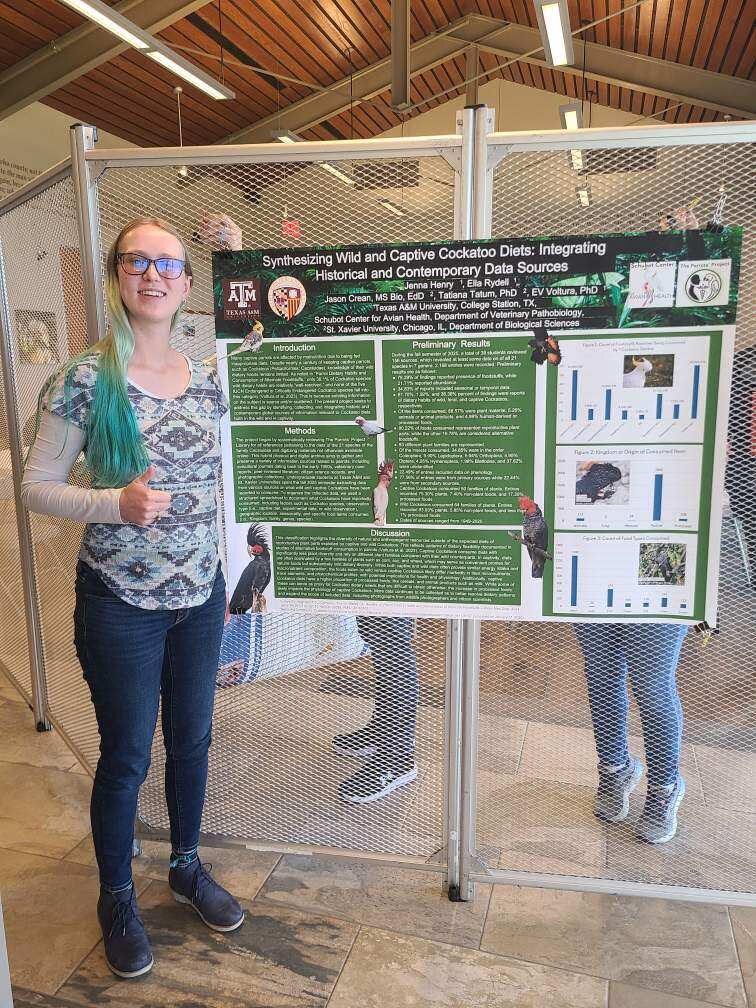
Jenna Henry smiling and giving a thumbs up beside the cockatoo diet research poster
Jenna Henry, a Texas A&M undergraduate researcher and student member of The Parrots’ Project through the Aggie Research Program since spring 2025, with the research poster she is lead author on, presented at a Rio Brazos Audubon Society event.

Preliminary findings

  • Wild and captive diets differ. Wild cockatoos were reported eating plants from 64 families and captive cockatoos from 50. Processed foods made up 17.30% of captive entries and less than 1% of wild entries.
  • Most foods were plants. 88.57% of the items eaten were plant material, from 83 plant families. Seeds were the most common food type, followed by fruit.
  • Foods beyond the expected. About one in five foods eaten (19.78%) were alternate foodstuffs rather than reproductive plant parts such as seeds, fruit, and flowers.
  • Gaps remain. Only 34.83% of reports included seasonal or timing information, and 37.62% of insects eaten were not identified.

Research poster

A Synthesis of Wild and Captive Cockatoo Diets: Integrating Historical and Contemporary Data Sources

Poster authors (in order): Jenna Henry, Ella Rydell, Jason Crean, Tatiana Tatum, and EV Voltura.

Jenna Henry and Ella Rydell (Texas A&M University), with Jason Crean, MS Bio, EdD and Tatiana Tatum, PhD (Saint Xavier University, Department of Biological Sciences) and EV Voltura, PhD (Texas A&M University, Schubot Center for Avian Health, Department of Veterinary Pathobiology).

See what a dietary record contains

The cockatoo dataset as an example

What one dietary record holds

Every one of the 2,188 entries records the same details, taken from its original source. Individual records are not published yet, so the card below shows the fields each record contains rather than a specific entry.

Example: record layout

Cockatoo dietary record

Species
One of the 21 species in the cockatoo family
Food item
Identified by kingdom, family, genus, and species, as far as the source allows
Food type
For example seed, fruit, flower, leaf, pulp, or insect
Observation type
Wild, feral, captive diet, or experimental data
Presence or abundance
Whether the source reports that the food was eaten, or how much
Location and season
Where and when the observation was made, if reported
Original source
Full citation, marked as a primary or secondary source

Comparing dietary records

A report of a captive bird eating a commercial cereal and a report of a wild flock feeding on native seed answer different questions. Keeping the observation type, place, and season with each record lets researchers compare like with like. In the current dataset, 61.70% of entries describe wild cockatoos, 36.38% captive birds, and 1.92% feral populations. 77.56% come from primary sources.

Example: proposed connection (not built yet)

  1. Cockatoo species
  2. Food item
  3. Plant family
  4. Original source

Once records are linked, a reader could start from one plant family, see every cockatoo species reported eating it in the wild or in captivity, and open the source behind each report. This illustrates a planned feature.

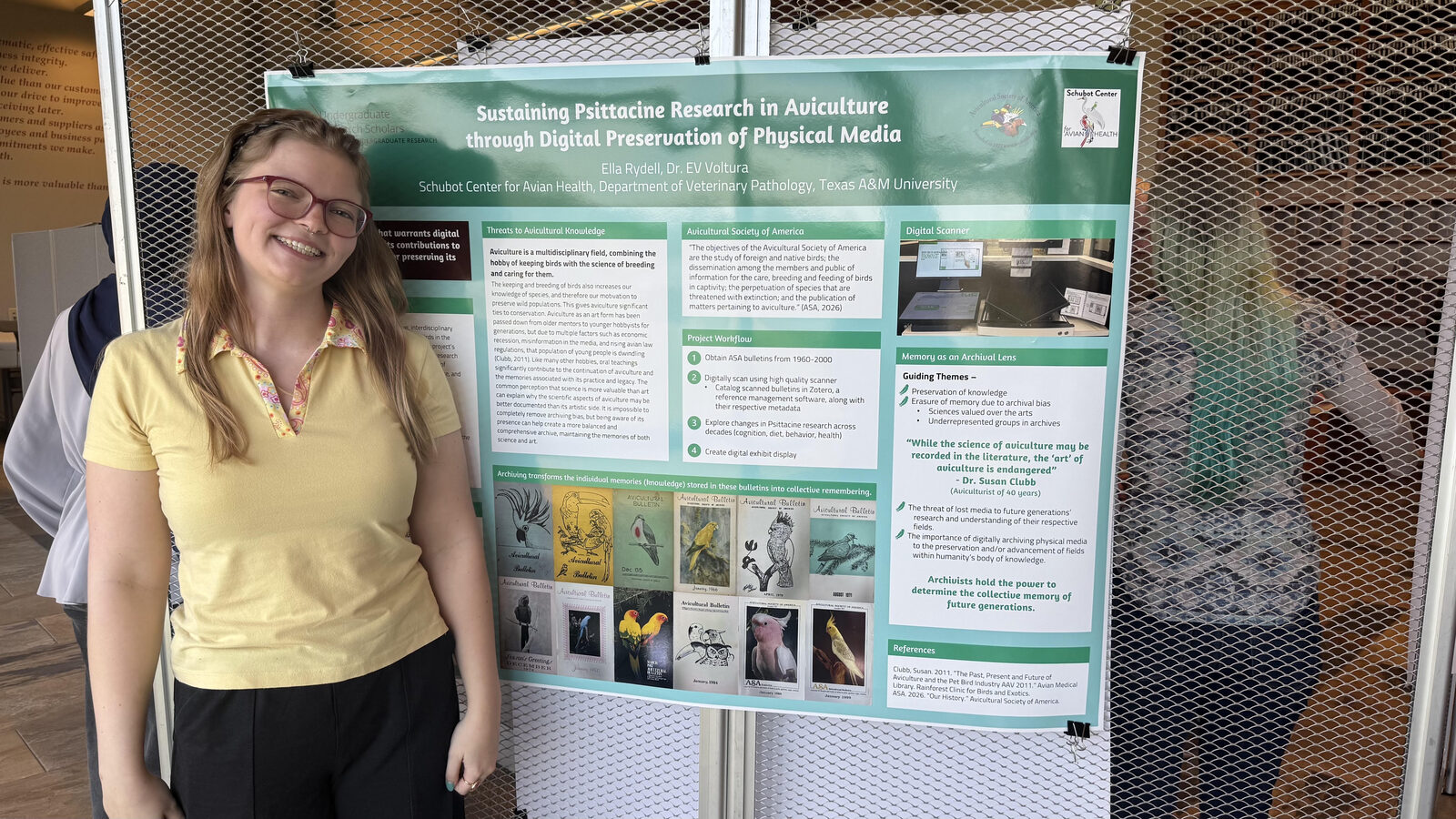
Ella Rydell smiling beside her research poster on digitizing Avicultural Society of America bulletins
Photograph: Ella Rydell presenting her project poster.

Featured student project

Research project in development

Preserving aviculture, one issue at a time

Project contributors: Ella Rydell, Jenna Henry, and EV Voltura, PhD.

During her time working with us, Ella Rydell helped document historical avicultural publications through her project, Sustaining Psittacine Research in Aviculture through Digital Preservation of Physical Media, mentored by Dr. EV Voltura.

Her project focused on the Avicultural Society of America’s Avicultural Bulletin, using physical materials generously donated by ASA and John York in 2025 and 2026.

What Ella documented

Ella cataloged 480 bulletin issues across 48 publication years, documenting 508 physical copies including duplicates. She organized holdings by year and month, identified gaps and duplicate copies, and recorded the birds depicted on bulletin covers.

A preliminary review of her cover inventory identifies at least 80 parrot species, including macaws, cockatoos, Amazons, lories, lorikeets, conures, and smaller parrots. Historical names and uncertain identifications remain under review. Repeated appearances, color varieties, and hybrids are not counted as additional species.

Examples include a Chattering Lory in March 1970, a Spix’s Macaw in September 1991 and May 1995, and a Rainbow Lory in April 1992. The covers also depict finches, pheasants, toucans, waterfowl, and other birds, capturing the breadth of the avicultural community’s interests.

Her inventories reach back to 1931, with particularly extensive holdings from 1961 through 2000. They provide a foundation for locating missing issues, organizing scans, and connecting publications with searchable bibliographic records.

These results are preliminary and remain subject to review and verification.

Preserving the people behind the pages

These bulletins preserve practical observations, research, artwork, and the experiences of generations of bird keepers. Ella’s project also considered how decisions about what gets preserved shape the history available to future generations.

Scanning is in progress. Copies of the scanned bulletins are being provided to the Avicultural Society of America, and any public access to them will come through ASA. Keep an eye on ASA’s website and announcements.

The Avicultural Bulletin exists because ASA members keep it going. Support the society that has shared avicultural knowledge for generations by becoming a member.

Become an ASA member

Ella has since graduated. Congratulations, Ella, and thank you for helping preserve this knowledge for the people and parrots who come after us!
James Guo
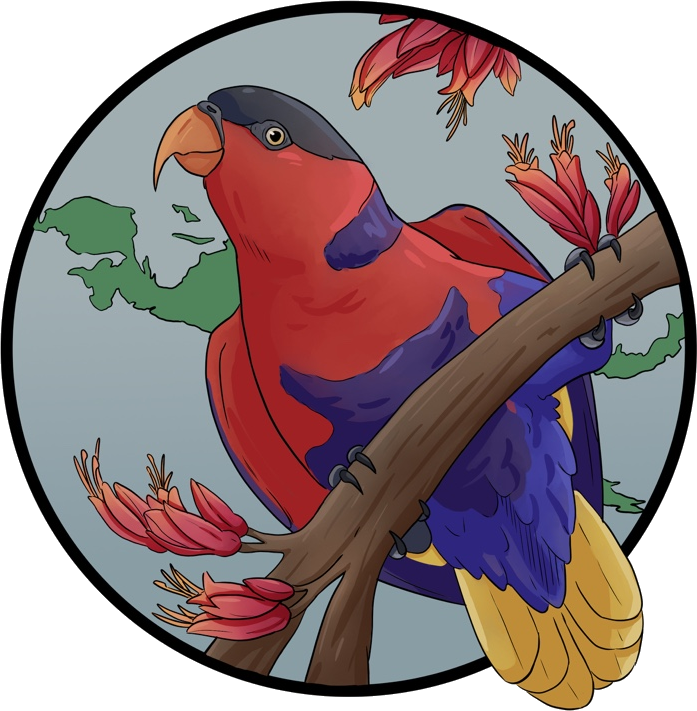
James Guo, leading the multilingual parrot names project.

Featured student project

Research project in development

Parrots by Many Names: Connecting Languages, Cultures, and Scientific Taxonomy

Project contributors: EV Voltura, PhD, James Guo, and Saerem Jung. James Guo leads the multilingual names research; Saerem Jung contributed the Korean translations. Additional undergraduate contributions are described below.

Research taken on and led by James Guo, with contributions from undergraduate researchers. As part of The Parrots’ Project, James has taken on the work of identifying, documenting, and interpreting multilingual parrot species names, beginning with Simplified and Traditional Chinese nomenclature. His approach provided a foundation that other undergraduate researchers subsequently expanded to include Hindi and Korean.

The collection brings together scientific names, historical taxonomic synonyms, and names across languages, preserving their original scripts. The supplied Chinese, Hindi and Korean names are native-speaker translations verified by undergraduate students. Individual student contributions are credited where known.

More than translation

Names may differ by region or reflect historical classifications. The supplied Chinese, Hindi and Korean translations were verified by undergraduate native speakers. Translation verification and evidence of established regional usage are recorded separately. Established names may also be found in regional sources, local traditions, or materials we have not yet explored. We welcome help from speakers and communities in finding and understanding them.

The developing collection distinguishes documented common names, verified native-speaker translations, proposed direct translations, and unverified names. By connecting names across languages and taxonomic systems, this work helps make scientific, historical, and practical knowledge about parrots easier to discover.

Explore the developing collection

Visit Species → Names & Taxonomy, explore the working-table excerpt, or see the Black-capped Lory working names. Independent references include Cornell Birds of the World, Avibase, iNaturalist, IUCN/BirdLife, and World Parrot Trust.

Native speakers, regional experts, and local communities are welcome to share names and sources. Please include the language and region where possible, respecting community preferences about attribution and publication.

These results are preliminary and remain subject to review and verification. This is ongoing student-led research, and names, translations, and taxonomic interpretations remain subject to verification.

Hyperspectral Imaging and Feather Spectral Library

Research project in development

Exploring how spectral measurements could connect feathers, physical specimens, and scientific knowledge. The library remains a developing research effort.

The Hidden Colors of Feathers: Building a Hyperspectral Library →