Blog / Research and Technology
The Hidden Colors of Feathers: Building a Hyperspectral Library
Exploring the information hidden in parrot feathers through hyperspectral imaging.
Research project in development
Parrots are among the most colorful animals on Earth, but what we see with our eyes is only part of the story.
Feathers contain information about how light interacts with pigments and microscopic structures, including wavelengths that humans cannot see. At The Parrots’ Project, we’re exploring how hyperspectral imaging can help us document and preserve this information through a developing spectral feather library.
What is hyperspectral imaging?
A conventional digital photograph records color using three broad channels: red, green, and blue.
Hyperspectral imaging works differently. It records information across many narrow wavelength bands, allowing researchers to examine how light interacts with a surface at different wavelengths.
The resulting dataset is often called a hyperspectral cube. Instead of one image, we effectively obtain many spatially aligned images, each representing a different part of the electromagnetic spectrum.
This allows us to investigate variations that might otherwise be invisible or difficult to distinguish.
Many birds are also capable of detecting ultraviolet wavelengths beyond normal human color vision. This makes spectral imaging particularly relevant to questions about avian coloration and communication.
What are we seeing?
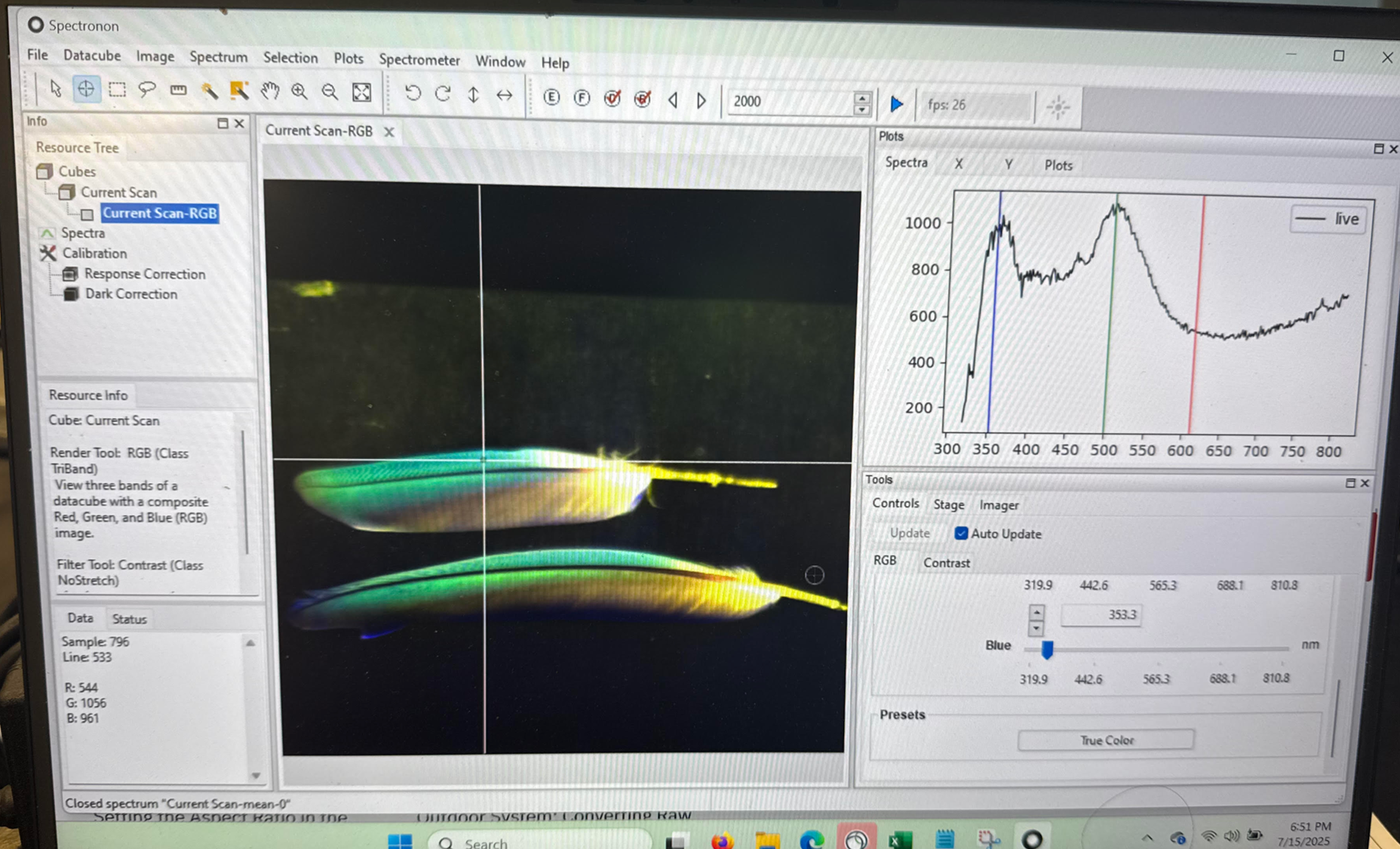
View the complete photograph and spectral graph at full resolution →
In this photograph, two Monk Parakeet flight feathers from the left wing are displayed alongside spectral measurements.
Notice how the feathers appear to have different colors along their lengths, even where their surfaces may look comparatively uniform under ordinary illumination.
The graph shows changes in recorded light intensity across the measured wavelengths, including part of the ultraviolet range.
These measurements can help us investigate spatial patterns and spectral differences that ordinary photographs do not capture.
However, accurately interpreting them requires appropriate calibration, measurement controls, and, when studying bird perception, models of avian visual systems. The displayed spectral signal should not automatically be described as calibrated reflectance.
One bird, thousands of feathers!
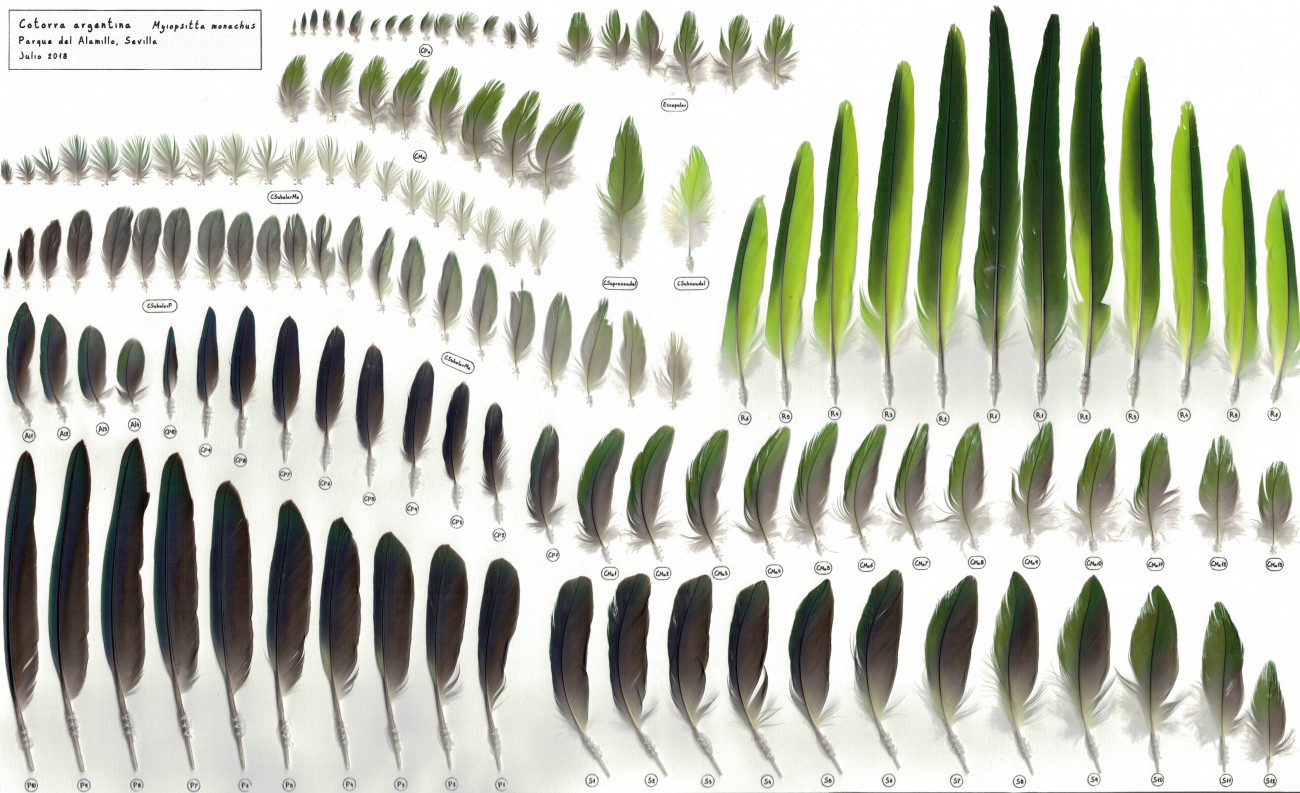
Now consider the challenge of building a spectral library.
A bird doesn’t have just one kind of feather. It has flight feathers, tail feathers, contour feathers, down, and other specialized feathers, each with different structural and functional characteristics.
A single bird may carry thousands of feathers. Feather counts vary substantially among species, and larger birds can have tens of thousands.
Even individual feathers may vary in coloration from tip to base, between their inner and outer vanes, and between their upper and lower surfaces.
Additional variation can arise from feather structure, age, wear, molt, individual differences, and the angle of observation or illumination.
If we want to build a scientifically useful spectral feather library, we cannot simply scan one feather from each species and assume it represents the entire bird.
We need to document what was measured, where the feather came from, how it was positioned, and the conditions under which its spectral data were collected.
That makes this a substantial scientific and data-management challenge, especially when we consider the diversity of parrots across the world.
Why build a spectral feather library?
Our goal is to explore how spectral measurements can be connected with physical specimens, species identification, anatomical information, and scientific literature.
A carefully documented library could eventually support research involving coloration, visual communication, feather identification, individual variation, and conservation.
It could also contribute to investigations of how feather colors develop and how their optical properties relate to underlying structures and pigments.
Importantly, we want to preserve the spectral measurements themselves, not just attractive visualizations.
This could allow future researchers to revisit the data as imaging methods, analytical tools, and our understanding of bird vision improve.
Learning from other researchers
In 2024, Benedict G. Hogan and Mary Caswell Stoddard published an open-access paper in PLOS Biology describing a hyperspectral imaging workflow for studying animal coloration.
Their research demonstrates how hyperspectral imaging can be combined with three-dimensional modeling and quantitative analysis to investigate the colors and visual patterns of animals.
This work provides an important methodological reference for researchers interested in studying coloration beyond conventional photography.
Connecting feathers to scientific knowledge
The spectral feather library is one part of our broader effort to preserve and connect knowledge about parrots.
As the project develops, we hope to establish connections between spectral data, physical specimens, historical taxonomy, scientific publications, and our other knowledge graphs.
Imagine being able to examine a feather, explore its measured spectral properties, identify relevant scientific research, and trace how the species itself has been classified over time.
These connections are part of the long-term vision for The Parrots’ Project.
The spectral library is still a developing research effort, and many technical, analytical, and logistical challenges remain.
Every feather has a story, and some of that story is written in wavelengths we cannot see.
We’re excited to begin exploring it.
Comments
Comments are reviewed before they appear. Comments are not veterinary advice. If your bird is unwell, please contact an avian veterinarian. Please be respectful and cite sources where you can.