Species collections / Psittacidae / Subfamily Arinae
Blue-bellied Parrot
Triclaria malachitacea (Spix, 1824)
Tribe Androglossini · Subfamily Arinae · Family Psittacidae (New World and African parrots)
Also known as the Purple-bellied Parrot, the name used by Rosemary Low, and in Brazil as the sabiá-cica.
Photo gallery ↓ · Avicultural knowledge ↓ · Names & Taxonomy · Read the 1997 article in The S.S. Squawks a Lot (em português)
Photo gallery
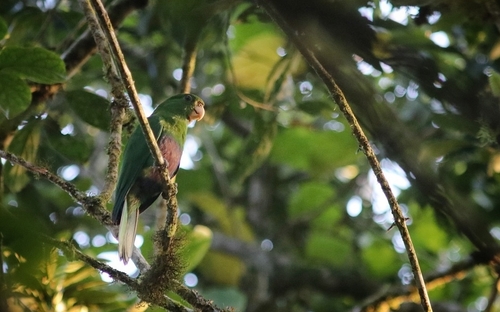
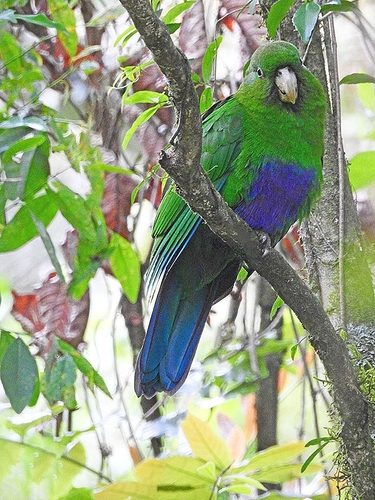
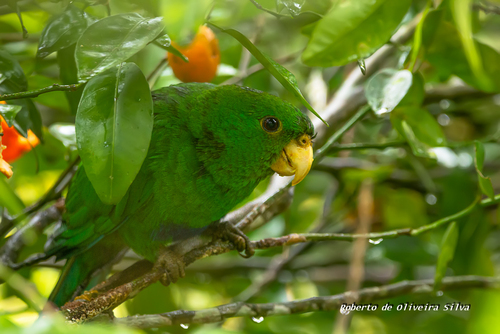
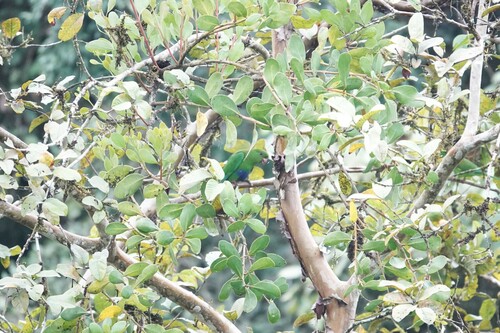
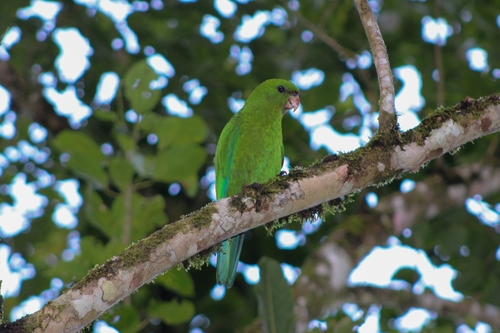
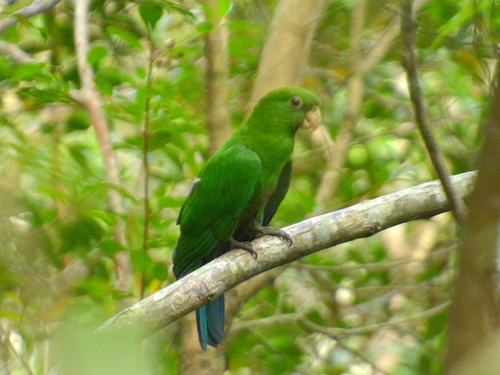
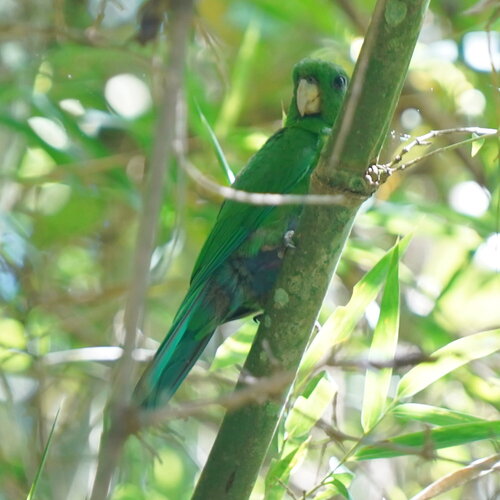
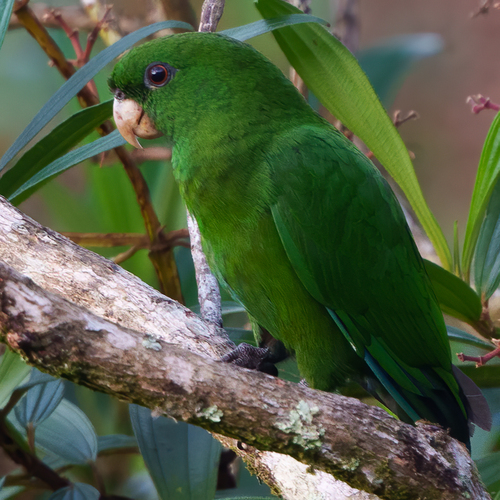
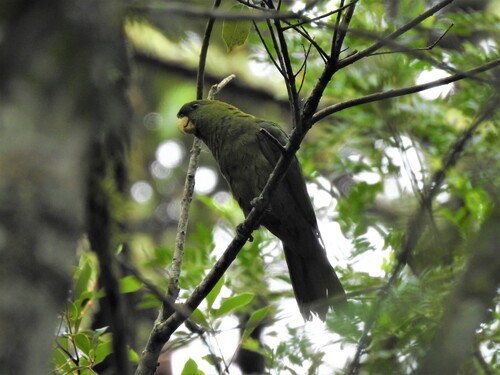
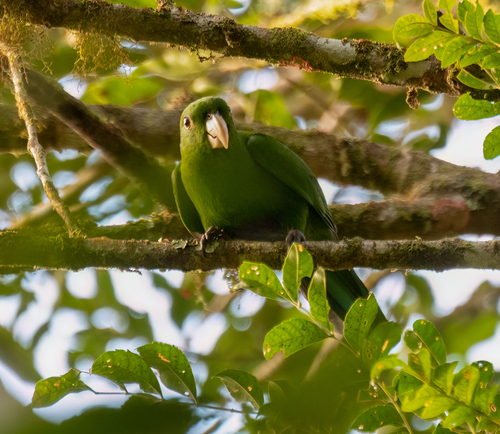
12 Creative Commons–licensed photos of Triclaria malachitacea from iNaturalist observers. Every photo is from a wild bird whose identification has been confirmed by the iNaturalist community. Age and sex are shown only where the observation records them. Photos remain the copyright of their photographers and are shown, resized but otherwise unedited, under the licence named with each one for non-commercial educational use. Select a photo to open its observation.

Natural history
The only species in its genus. A slim, uniformly dark green parrot about 30 cm long, with a long, broad tail that is blue below and at the tip, large brown eyes and almost no bare skin around them. Adult males have a large violet-blue patch on the abdomen; females and young birds lack it (Low (1997)).
Unusually for a parrot, it sings: a clear, thrush-like song, which gave it its Brazilian name, sabiá-cica (sabiá is the Brazilian name for thrushes). It lives mainly in the forest interior and lower strata, and in captivity dislikes strong sun (Low (1997)).
Geographic range
Endemic to the Atlantic Forest of south-eastern Brazil, where Rio Grande do Sul is regarded as its stronghold (Birds of the World ). Low (1997), citing Collar, Crosby and Stattersfield (1994), lists records from Bahia south to Rio Grande do Sul and two records from Argentina.
Sounds & Vocalizations
Listen to recordings in the Macaulay Library.
Cornell Lab of Ornithology, Macaulay Library.
Avicultural knowledge
| Measure | Record | Source |
|---|---|---|
| Eggs per clutch | 4 (two females, Loro Parque, 1988); 6 (Palmitos Park, every clutch) | Low (1997), p. 155 |
| Clutches per season | Not recorded. Laying began in April or May at Palmitos Park and in January at Loro Parque (1988) | Low (1997), p. 155 |
| Laying interval | Alternate days | Low (1997), p. 155 |
| Incubation period | Usually 28–30 days from laying to hatching in the nest (up to 34 days for the last of six eggs); 25 days for one egg in an incubator | Low (1997), p. 155–156 |
| Egg size | Not recorded | — |
| Weight at hatching | About 6 g | Low (1997), p. 156 |
| Eyes open | About 18 days (ears about 12 days) | Low (1997), p. 156 |
| Ring size | 6.5 mm, fitted at about 14 days | Low (1997), p. 156 |
| Peak chick weight | 156 g at 32 days, parent-reared (about 10 g above average) | Low (1997), p. 156 |
| Days to fledge | About 56 days (eight weeks in the nest) | Low (1997), p. 157 |
| Independence | About nine weeks, at 120–148 g (hand-reared) | Low (1997), p. 157 |
| Adult weight | About 140 g | Low (1997), p. 149 |
| Adult length | 30 cm, of which the tail is about 12 cm | Low (1997), p. 149 |
| Nest-box | About 20 cm square and 31 cm high (as recalled) | Low (1997), p. 155 |
The species has always been rare in aviculture, and little has been published about it in captivity. The most detailed account is Rosemary Low’s, drawing on 27 years with the species in her own collection in England, at Loro Parque (Tenerife) and at Palmitos Park (Gran Canaria). It is summarized here; Low (1997) is available in full, with translations, in The S.S. Squawks a Lot.
Newly imported birds were notoriously hard to establish, probably because they would not try unfamiliar foods. Birds did well in large planted aviaries with fresh branches and saplings to strip; without fresh branches to gnaw, beaks could overgrow. Captive birds ate fruits (especially guavas), berries, corn, greenfood, vegetables and seeds. In the wild, the field studies Low cites recorded native seeds and fruit pulp, maize, wood and bark.
Incubation probably began with the second egg, so chicks in a clutch hatched days apart. Low thought the long nest incubation periods reflected erratic sitting once most chicks had hatched, and that the true period under good conditions was nearer the 25 days of the incubator egg. Several young were hand-reared after bacterial infections; they were eating well on their own by seven weeks. Low’s original 1991 weights for two hand-reared chicks are reproduced in full.
Young birds resemble females and cannot be sexed by abdomen colour; replacement feathers plucked from the abdomen show the sex. The bare skin around the eye is white in young birds and grey in adults.
All 34 observations from Low (1997), sorted by topic
Diet, breeding and chick-development observations from Low (1997), organised so they can later be added to diet datasets such as CROPd and to species knowledge graphs. Wild and captive observations are kept apart, and Rosemary Low’s firsthand observations are separated from findings she cites from other researchers. Each record gives its source and the printed page. These are historical observations from 1997 and earlier, not a care guide or a current status assessment.
Diet in the wild
WildCited by Low
- Main foods are the seeds and pulp of several common native plants, especially of the families Euphorbiaceae and Myrtaceae, and cultivated maize. (Bencke (1996); Central-eastern Rio Grande do Sul, Brazil; p. 151)
- Moves to second-growth stands at the maize harvest; maize is one of its main foods at this time. (Bencke (1996); Central-eastern Rio Grande do Sul, Brazil; p. 151)
- Some foods are keystone resources because they fruit, and are eaten, over extended periods, are plentiful when overall fruit diversity is low, or are the main food in the breeding season. (Bencke (1996); Central-eastern Rio Grande do Sul, Brazil; p. 151)
- Not observed feeding on buds or nectar; seen eating wood and bark. (Bencke (1996); Central-eastern Rio Grande do Sul, Brazil; p. 151)
- Fruits of the palm Euterpe edulis are not a particularly important food resource in Rio Grande do Sul. (Bencke (1996); Rio Grande do Sul, Brazil; p. 150)
- Fruits of the palm Euterpe edulis described as a main food source, for which the species competes with people who destroy the plant. Contrasts with diet-wild-05 and diet-wild-07. (Collar, Crosby & Stattersfield (1994), quoting Collar et al. (1992); Atlantic Forest, Brazil; p. 150)
- Of six parrot species studied, only Pyrrhura frontalis was observed feeding on Euterpe edulis fruits; Triclaria was not. (Pizo, Simão & Galetti (1995); Atlantic Forest, Brazil; p. 150)
- The only food item listed for Triclaria was the seed of the guava Psidium guajava. (Pizo, Simão & Galetti (1995); Parque Estadual Intervales, south-eastern Brazil; p. 153)
The sources disagree on the importance of the palm Euterpe edulis.
Diet in captivity
CaptiveLow, firsthand
- Low saw Murray’s birds hawking flies in a large aviary. (Low (1997), firsthand; Essex, England (Herbert Murray’s aviary); p. 152)
- Grapes attached to a branch; nectar with added vitamins, spray millet, sunflower, peanuts, pine nuts, niger and canary seed; later various fruits, berries and corn on the cob. (Low (1997), firsthand; England (Low’s own pair); p. 153)
- The male’s preferences, in order: cherries, grape pips, buds or bark from trees, spray millet. (Low (1997), firsthand; England (Low’s own male); p. 153)
- Ate a wide variety of fruits including guavas and cactus fruits, greenfoods, and raw carrot and courgettes; basic mixture of seeds, cooked maize and cooked beans (not much liked); fresh corn a favourite; never seen hawking insects. (Low (1997), firsthand; Palmitos Park, Gran Canaria; p. 153)
- Hand-rearing food: a mixture of Milupa baby cereal, wheat germ cereal, Nekton Lori and liquidised papaya. (Low (1997), firsthand; Palmitos Park, Gran Canaria; p. 158)
- Needs frequent fresh branches for gnawing; without them some birds develop an overgrown beak. Hardy and tolerant of low temperatures but dislikes strong sunlight. (Low (1997), firsthand; Captivity (general); p. 152)
Diet in captivity, another keeper
CaptiveReported by Low
- Birds in a large planted aviary were given 8ft (2.4m) saplings each week and fed on the bark and leaves “in a frantic manner”; they took fruit only if it was hung from a perch. (Low (1997), on Herbert Murray’s birds; Essex, England; p. 153)
Breeding in the wild
WildCited by Low
- Three nests were all at a low height, 3m to 5m (approx. 10ft–17ft) above ground, making them vulnerable to poaching. (Bencke (1996); Santa Cruz do Sul, Rio Grande do Sul, Brazil; p. 150)
Breeding in captivity
CaptiveLow, firsthand
- The female laid in April or May and always laid six eggs; the nest-box was approximately 8in (20cm) square and 12in (31cm) high, as recalled. (Low (1997), firsthand; Palmitos Park, Gran Canaria; p. 155)
- Two pairs. One female laid her first egg on 7 January; the other laid in January (day illegible on the photographed page). Both laid four eggs. (Low (1997), firsthand; Loro Parque, Tenerife; p. 155)
- Eggs laid on alternate days; incubation probably began with the second egg. The first egg usually hatched 30 days after laying, the others after about 28 days; the last egg of six could hatch up to 34 days after laying. (Low (1997), firsthand; Loro Parque and Palmitos Park; p. 155)
- True incubation period under optimum conditions as short as 25 days, in one egg placed in an incubator. (Low (1997), firsthand; Captivity (incubator); p. 156)
- Male courtship display: wings opened, body lowered, a series of notes like “chit-chit-chit-chit-choowit”; tail spread, abdomen feathers puffed out, eye blazing, rapid head shaking, beak rubbed on perch. A responsive female shakes her head and sings quietly. (Low (1997), firsthand; Captivity; p. 153)
Chick development in captivity
CaptiveLow, firsthand
- Newly hatched chicks have long off-white down on the back, a little on the nape and virtually none on the head; beak almost unpigmented with a faint brown tinge; weight about 6g. (Low (1997), firsthand; Palmitos Park and Loro Parque; p. 156)
- Light grey and mid-grey second down erupts at about two weeks; ears open at about 12 days; eyes open at about 18 days; wings and head feather first, crop area and neck last; feathers start to erupt at about three weeks. (Low (1997), firsthand; Palmitos Park and Loro Parque; p. 156)
- Chicks ringed with 6.5mm rings at about 14 days. (Low (1997), firsthand; Palmitos Park; p. 156)
- Highest weight recorded in parent-reared young was 156g at 32 days, about 10g more than average. Chicks were not weighed after about five weeks. (Low (1997), firsthand; Palmitos Park (parent-reared); p. 156)
- Feet start to darken at about one week and are dark grey at fledging; the young spend eight weeks in the nest. (Low (1997), firsthand; Palmitos Park (parent-reared); p. 157)
- Eating well alone by seven weeks; independent at about nine weeks, weighing 120g–148g. (Low (1997), firsthand; Palmitos Park (hand-reared after bacterial infections); p. 157)
- Newly fledged young resemble females and cannot be sexed by abdomen colour; replacement feathers on the abdomen indicate sex. Bare periophthalmic skin is white in immatures and grey in adults. (Low (1997), firsthand; Captivity; p. 157)
- Daily weights of two hand-reared chicks, before and after the first feed; see chickWeights. (Low (1997), firsthand; Palmitos Park; p. 158)
Behaviour, voice and habitat in the wild
WildCited by Low
- Normally in pairs (45% of records where numbers could be estimated); up to three pairs may gather, usually early morning, vocalising continually with agonistic contacts while pairs stay segregated. (Bencke (1996); Central-eastern Rio Grande do Sul, Brazil; p. 151)
- Lives in the shade of moister valleys at 300m–1,000m and moves seasonally to lower areas. (Collar, Crosby & Stattersfield (1994); Atlantic Forest, Brazil; p. 150)
- Restricted to the largest remnants of mature forest on hilltops and steep slopes; uses connected secondary woodland; lives mainly in the forest interior and lower strata. Population on the escarpment estimated at a maximum of 10,000 individuals (historical estimate, not a current figure). (Bencke (1996); Serra Geral escarpment, Rio Grande do Sul, Brazil; p. 151)
Voice
CaptiveLow, firsthandMoojen, cited
- The Indian name Sabia-cica refers to a thrush or robin because of its melodious, soft, thrush-like song; Moojen states the birds learn new songs or imitate the human voice. Low disagrees about imitating the human voice. (Moojen (1960); Brazil; p. 153)
- Male song clear and thrush-like, a few notes repeated loudly; also a very quiet whistle like a Blackbird’s sub-song. Females whistle quietly; full song heard only from a male. Alarm call “chack-chack”. Sang joyfully on cold, frosty mornings. (Low (1997), firsthand; England (Low’s own male); p. 153)
Chick-weight table, Palmitos Park, 1991 · Download all 34 observations and the chick weights (JSON)
These are historical observations of a few captive birds, not a care guide. For advice about an individual bird’s health or care, consult an avian veterinarian.
Conservation status
- IUCN category
- Least Concern
- Assessment
- BirdLife International, 2022 · IUCN Red List species page
- Date checked
- 28 November 2026
- CITES
- Appendix II (as part of the listing for all parrots, Psittaciformes, not otherwise listed)
Earlier assessments placed this species in higher threat categories. Rosemary Low’s 1997 article, written under those earlier assessments, describes it as endangered; that is a historical assessment, not its current status. See the BirdLife DataZone factsheet for the current assessment details.
Names & taxonomy
Taxonomic rank: Species. Accepted at species rank in eBird/Clements v2026 as Triclaria malachitacea, Blue-bellied Parrot, family Psittacidae. Matched in Cornell’s versioned eBird taxonomy API on 28 November 2026. View the versioned taxonomy match . Placed in tribe Androglossini, subfamily Arinae, by Joseph et al. (2012).
- Scientific name
- Triclaria malachitacea (Spix, 1824)
- Also known as
- Purple-bellied Parrot (the name used in Low (1997) and by some avicultural sources); sabiá-cica (Brazil)
- Historical names
- Violet-bellied Parrot, Triclaria cyanogaster (as used by Seth-Smith, 1907, quoted in Low (1997))
- Group
- Subfamily Arinae (tribe Androglossini)
- Family
- Psittacidae (New World and African parrots)
- Genus
- Triclaria Wagler, 1832 (monotypic)
- Cornell species code
blbpar4- Avibase concept ID
F04B11414D6480AF
Subspecies
Birds of the World (Clements taxonomy) . Monotypic: no subspecies are recognized.
Documented names in other languages
Names from the multilingual name list supplied to the project on 28 November 2026, which also matches the Avibase concept for this species. Regional usage has not been independently reviewed.
- Afrikaans: Perspenspapegaai
- Bulgarian: Синьокорем папагал
- Catalan: Lloret panxablau
- Czech: amazoňan modrobřichý, Papoušek malachitový
- Danish: Blåbuget Papegøje
- German: Blaubauch, Blaubauchpapagei, Blaubauch-Papagei
- English: Blue-bellied Parrot (AviList, HBW, IOC and US usage); also Blue bellied Parrot, Purple-bellied Parrot
- Esperanto: bluventra papago
- Spanish: Loro Cica, Loro de vientre azul, Loro Sabiá-cicá, Loro Ventriazul
- Spanish (Argentina): Loro Cica, Loro de vientre azul
- Spanish (Spain): Loro Ventriazul
- Estonian: laulupapagoi
- Finnish: Purppuravatsaamatsoni, sinivatsa-amatsoni
- French: Caïque à ventre bleu, Crick à ventre bleu
- French (French Guiana): Crick à ventre bleu
- Croatian: plavotrba papiga
- Hungarian: malachitpapagáj
- Icelandic: Purpurapáfi
- Italian: Pappagallo dal ventre malachite, Pappagallo panciablu
- Japanese: アオハラインコ (aoharainko)
- Lithuanian: Mėlynpilvė papūga
- Dutch: Paarsbuikparkiet
- Norwegian (Nynorsk): Blåbukpapegøye
- Norwegian (Bokmål): Blåbukpapegøye
- Polish: malachitka
- Portuguese: araçoiaba, araçuaiava, cica, Papagaio-de-peito-roxo, sabiá-ci, sabiá-cica
- Portuguese (Brazil): araçoiaba, araçuaiava, cica, sabiá-ci, Sabiá-cica
- Portuguese (Portugal): papagaio-de-barriga-azul, Sabiá-cica
- Russian: Синебрюхий попугай
- Slovak: malachitka modrobruchá
- Serbian: Plavotrbi papagaj (malahita)
- Swedish: blåbukig papegoja, Violettbukad papegoja
- Turkish: Mavi karınlı papağan
- Ukrainian: Папуга синьочеревий
- Chinese (Simplified): 蓝腹鹦哥
- Chinese (Traditional): 藍腹鸚哥
Scientific synonyms: Psittacus cyanogaster, Psittacus malachitaceus, Triclaria malachitacea.
The translations of Low (1997) render her name Purple-bellied Parrot literally (for example papagaio-de-barriga-roxa, loro de vientre púrpura, perroquet à ventre pourpre, Purpurbauchpapagei, 紫腹鹦鹉); these are translations of the article’s wording, not documented names.
Explore This Species Elsewhere
Independent resources, credited to their publishers. Links do not imply endorsement or partnership.
- Cornell Lab of Ornithology | Birds of the World : Species account and distribution. Full account access may require a subscription.
- eBird : Observations, maps, photographs and sounds.
- iNaturalist : Community observations and photographs. Observations are not necessarily independently verified scientific evidence.
- Avibase : Compare checklist treatments, synonyms and documented common names.
- IUCN Red List : Global extinction-risk assessment.
- BirdLife DataZone : BirdLife International factsheet.
Sources
- Low, R. (1997). The Purple-bellied Parrot Triclaria malachitacea: its natural history and aviculture. Avicultural Magazine 103(4): 149–158 (description, song, diet, behaviour and breeding in captivity, chick growth; wild observations cited from Bencke 1996, Collar et al. 1994 and Pizo et al. 1995)
- Cornell eBird taxonomy API — v2026 species rank, scientific name and family (checked 28 November 2026)
- Collar, N. and P. F. D. Boesman (2020). Blue-bellied Parrot (Triclaria malachitacea), version 1.0. Birds of the World — monotypic status and distribution (checked 28 November 2026)
- BirdLife International (2022). Triclaria malachitacea. The IUCN Red List of Threatened Species 2022: e.T22686419A209540315 (category)
- Joseph, L., A. Toon, E. E. Schirtzinger, T. F. Wright and R. Schodde (2012). A revised nomenclature and classification for family-group taxa of parrots (Psittaciformes). Zootaxa 3205: 26–40 (tribe Androglossini)
- CITES Appendices I, II and III
- iNaturalist taxon metadata and multilingual names — Triclaria malachitacea (checked 28 November 2026)
- Wikidata — authority (Spix, 1824), Avibase concept ID and IUCN taxon ID for Triclaria malachitacea (checked 28 November 2026)
Contribute to this species page
Do you keep or have observed Blue-bellied Parrots, or know a local name for this species? We welcome corrections and sources. Contact us.