Blog / Diet and Nutrition
What’s on the Menu? Cockatoo Diets in the Wild and in Captivity
What can we learn from the natural feeding habits of cockatoos, and how might we use this knowledge to enrich the lives of the birds in our care?
Did you know that many of the staple foods consumed by cockatoos in the wild are rarely recorded in the diets of their captive counterparts?
As part of The Parrots’ Project, we have been working to compile information on the dietary habits of parrots from around the world.
Our first interactive cockatoo menu brings together 10,238 dietary records, representing 1,159 different foods across all 22 species of cockatoos. These records span more than a century and come from scientific literature, avicultural publications, and observations contributed by hundreds of community scientists through iNaturalist, the Macaulay Library (eBird), and GBIF.
One of the things I find particularly interesting is how little overlap there appears to be between the staple foods of wild cockatoos and the foods they consume in captivity.
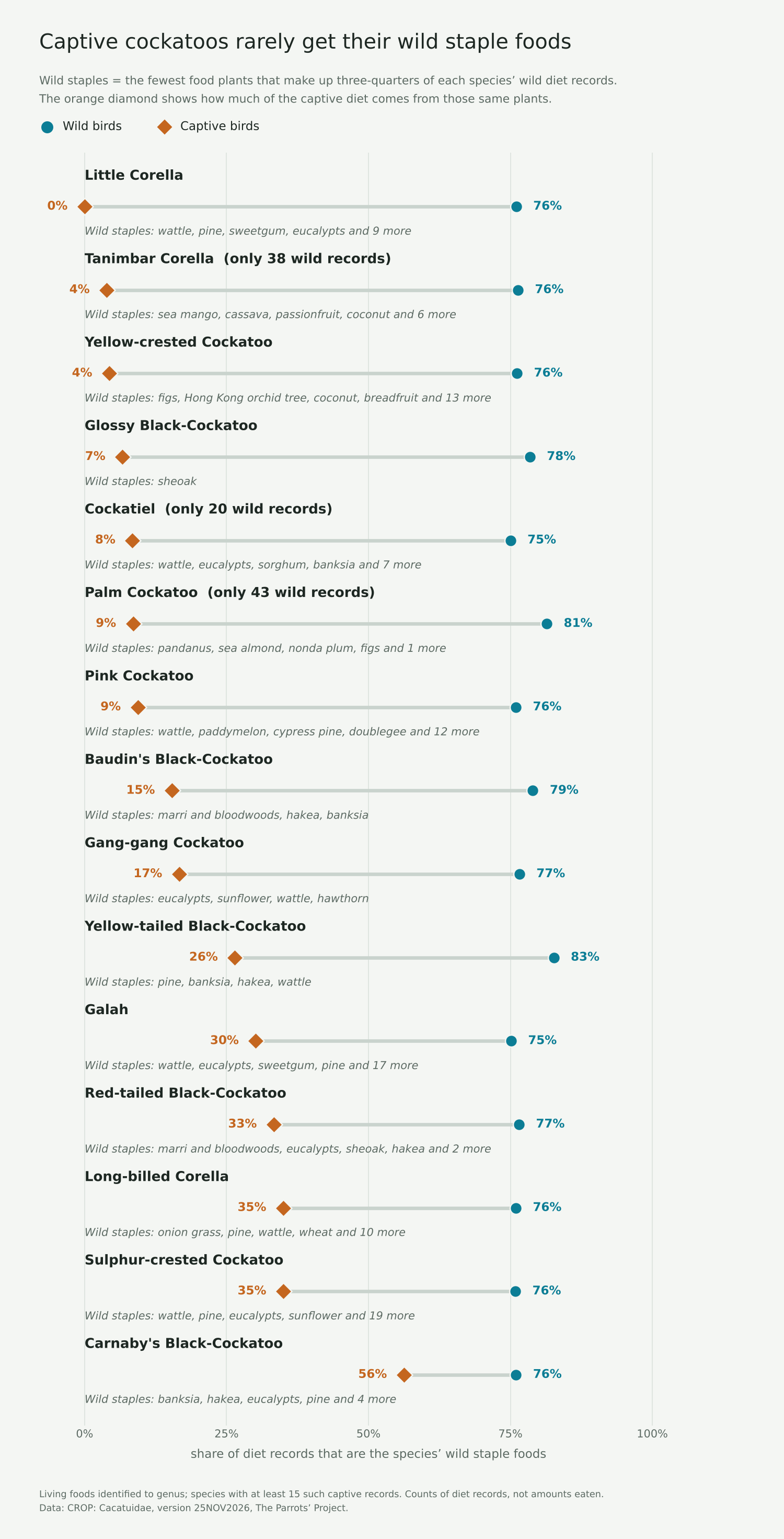
For example, pandanus, sea almond, nonda plum, and figs feature prominently in the wild dietary records of Palm Cockatoos, yet collectively represent only about 9% of their captive dietary records.
Marri, hakea, and banksia feature prominently in the natural diets of several black-cockatoo species, yet appear relatively infrequently in their captive dietary records.
Even among more generalist species, such as the Galah and Sulphur-crested Cockatoo, there appear to be considerable differences between their wild and captive menus.
Is This Necessarily a Bad Thing?
No! Our parrots do not need to consume the exact same foods as their wild counterparts to be healthy.
However, it does raise some interesting questions.
Are our captive parrots missing out on potentially beneficial plant compounds that are particularly abundant in their wild foods? What roles might these compounds play in their physiology, gastrointestinal microbiota, immune function, and long-term health?
When we think about nutrition, we tend to focus on proteins, fats, carbohydrates, vitamins, and minerals. Plants, however, contain an extraordinary diversity of other biologically active compounds, collectively referred to as phytochemicals.
Flavonoids, such as quercetin and kaempferol, have been investigated for their antioxidant and anti-inflammatory properties. Phenolic acids, such as gallic acid, may influence microbial activity and oxidative stress. Phytosterols can influence cholesterol absorption, while carotenoids have roles in pigmentation, antioxidant activity, and, in some cases, vitamin A nutrition.
Tannins are particularly interesting. Although often discussed in the context of their potential to interfere with nutrient absorption, they may also influence gastrointestinal microbial communities and have antimicrobial properties. Their biological effects depend considerably on their chemical structure and the quantities consumed.
Take a moment to look up some of the plants in the genus Banksia, for example.
These remarkable Australian plants feature prominently in the diets of several cockatoo species. Researchers have documented condensed tannins in Banksia seed pods, while studies of Banksia-derived honey have identified several flavonoids, including quercetin, myricetin, luteolin, and tricetin.
This does not necessarily mean that these same compounds are present in comparable concentrations in the seeds that cockatoos consume. That, in itself, is an interesting question worthy of further investigation.
Eucalyptus is another interesting example. Plants within this genus produce a diversity of terpenoids and phenolic compounds, including 1,8-cineole, commonly known as eucalyptol.
What happens when an animal that has evolved alongside a particular diversity of plants is no longer regularly exposed to their chemical constituents?
We simply do not know.
Some of these compounds may be beneficial, others may have little biological significance, and some may be detrimental at certain concentrations.
We are certainly not suggesting that parrots require every compound found in their wild foods or that we should begin supplementing their diets with isolated phytochemicals, essential oils, or concentrated plant extracts.
Rather, it is worth considering that two foods with similar nutritional profiles may have very different phytochemical profiles.
Understanding Dietary Proxies
In captivity, we frequently rely on what we call dietary proxies.
A dietary proxy is a food that we use in place of another food, often because the original food is not readily available to us.
For example, we might offer commercially available nuts in place of the native seeds and nuts that a cockatoo would encounter in its natural habitat. Similarly, we might offer cultivated fruits in place of the fruits that a parrot would naturally consume in the forests of South America, Africa, or Indonesia.
Although these foods may provide similar nutrients or opportunities for foraging, they are not necessarily nutritionally or chemically equivalent.
This is one of the reasons I am such a proponent of dietary diversity.
When we are relying on dietary proxies, offering a diversity of appropriate foods may help broaden nutritional coverage and expose our birds to a greater variety of naturally occurring plant compounds.
Given how much remains unknown about the nutritional requirements of individual parrot species, I think there is considerable value in providing this diversity alongside a nutritionally balanced foundational diet.
We do not necessarily need to recreate the wild diet. We can, however, learn from it.
Beyond the Pellet
I encourage providing a good-quality, nutritionally balanced pellet as the foundation of the diet for most companion cockatoos. My personal preference is for organic pellets without artificial dyes.
A good foundational diet can be complemented by a diversity of fresh, frozen, and freeze-dried foods.
Yes, you can even offer appropriate foods while they are still frozen as an occasional treat! This can be particularly fun during those hot summer months.
Freeze-dried foods are another wonderful option. Freeze-drying is one of the most effective methods of retaining many of the nutrients found in fresh foods and can make it easier to offer a greater diversity of foodstuffs throughout the year, particularly those that are only seasonally available.
Dietary enrichment is not just about nutrition. It is also about providing opportunities to investigate, manipulate, dismantle, and explore food.
Anyone who has lived with a cockatoo knows just how much enthusiasm they can bring to the dismantling part!
Fresh branches, flowers, seed pods, and other appropriate botanical materials can provide opportunities for our parrots to engage in some of the feeding and foraging behaviors exhibited by their wild counterparts.
Sometimes, the experience of accessing the food may be just as interesting to the bird as the food itself.
Where Can We Find Some of These Foods?
One wonderful resource for those interested in exploring less conventional foodstuffs is Biodiversity Bird Blends.
They often carry Australian botanical foods that many of us would otherwise have difficulty sourcing.
These are not just for cockatoos, either! Many appropriate botanical foodstuffs can provide interesting dietary and behavioral enrichment opportunities for other species of parrots.
You can also find fresh eucalyptus branches through sellers on marketplaces such as Etsy. Be sure to source correctly identified, bird-safe plants that have not been treated with pesticides or other potentially harmful chemicals.
Perhaps some of you even grow appropriate plants in your own gardens!
Hopefully, we will see more of these types of foodstuffs becoming commercially available in the future.
For those interested in learning more about incorporating alternative foodstuffs into captive parrot diets, I also encourage you to check out our paper on parrot dietary habits and the consumption of alternate foodstuffs.
Please let me know if you would like a copy!
Who Eats What? Explore the Cockatoo Menu
Our new interactive resource, Who Eats What: The Cockatoo Menu, allows you to explore the recorded diets of individual cockatoo species and compare what they consume in the wild with what they consume in captivity.
You can investigate which parts of plants different cockatoo species consume, explore the diversity of seeds, fruits, and nuts in their diets, and search through the hundreds of individual foodstuffs currently represented in the database.
There are some rather interesting discoveries to be made.
Glossy Black-Cockatoos appear to be remarkably specialized in their feeding habits, with she-oak seeds dominating their wild dietary records.
Cockatiels, on the other hand, have over 200 different foodstuffs represented in our database.
Insects and insect larvae also appear in the dietary records of numerous cockatoo species, something we might not immediately associate with parrots!
You might even discover something your own cockatoo has never tried.
The interactive menu complements our existing Cockatoo Knowledge Graph. While the knowledge graph connects scientific findings and their supporting literature, the interactive menu provides an opportunity to explore the individual dietary records themselves.
You can find the interactive menu on our Research page, and the knowledge graph through the Graphs menu on The Parrots’ Project website.
A Growing Resource
This resource would not have been possible without the efforts of our student researchers, the researchers and aviculturists who have documented the feeding habits of parrots over many decades, and the 945 community scientists whose observations have contributed to this first version.
Every contributing community scientist is credited on the interactive menu, alongside the published sources from which we have extracted dietary records.
This is only the first version (Version 25NOV2026). We have many more references to work through, records to verify, and questions to explore.
It is also important to remember that the proportions presented in our visualizations reflect the frequency of dietary records rather than the actual quantities of foods consumed. Some species are also considerably better represented in the literature and community science records than others.
These preliminary comparisons are intended to help us explore patterns and identify questions for future research, not to establish nutritional deficiencies in captive birds.
Now, a Question for You
What kind of cockatoo do you have?
Have you ever offered your bird some of the foods that their wild counterparts consume?
Do you have a favorite resource for sourcing unusual foodstuffs, fresh browse, or native plants? Perhaps you grow some of these plants yourself?
We would love to hear about your experiences in the comments and share resources with others who are interested in exploring new ways to enrich the lives of their parrots.
There is still so much we have to learn about parrot nutrition. The more we can bring together the knowledge of researchers, veterinarians, aviculturists, and the people who share their daily lives with parrots, the more opportunities we have to discover something new.
We are all learners here.
The Parrots’ Project — Connecting the world of parrot knowledge.
Explore the interactive cockatoo menu →
Comments
Comments are reviewed before they appear. Comments are not veterinary advice. If your bird is unwell, please contact an avian veterinarian. Please be respectful and cite sources where you can.