Featured reference
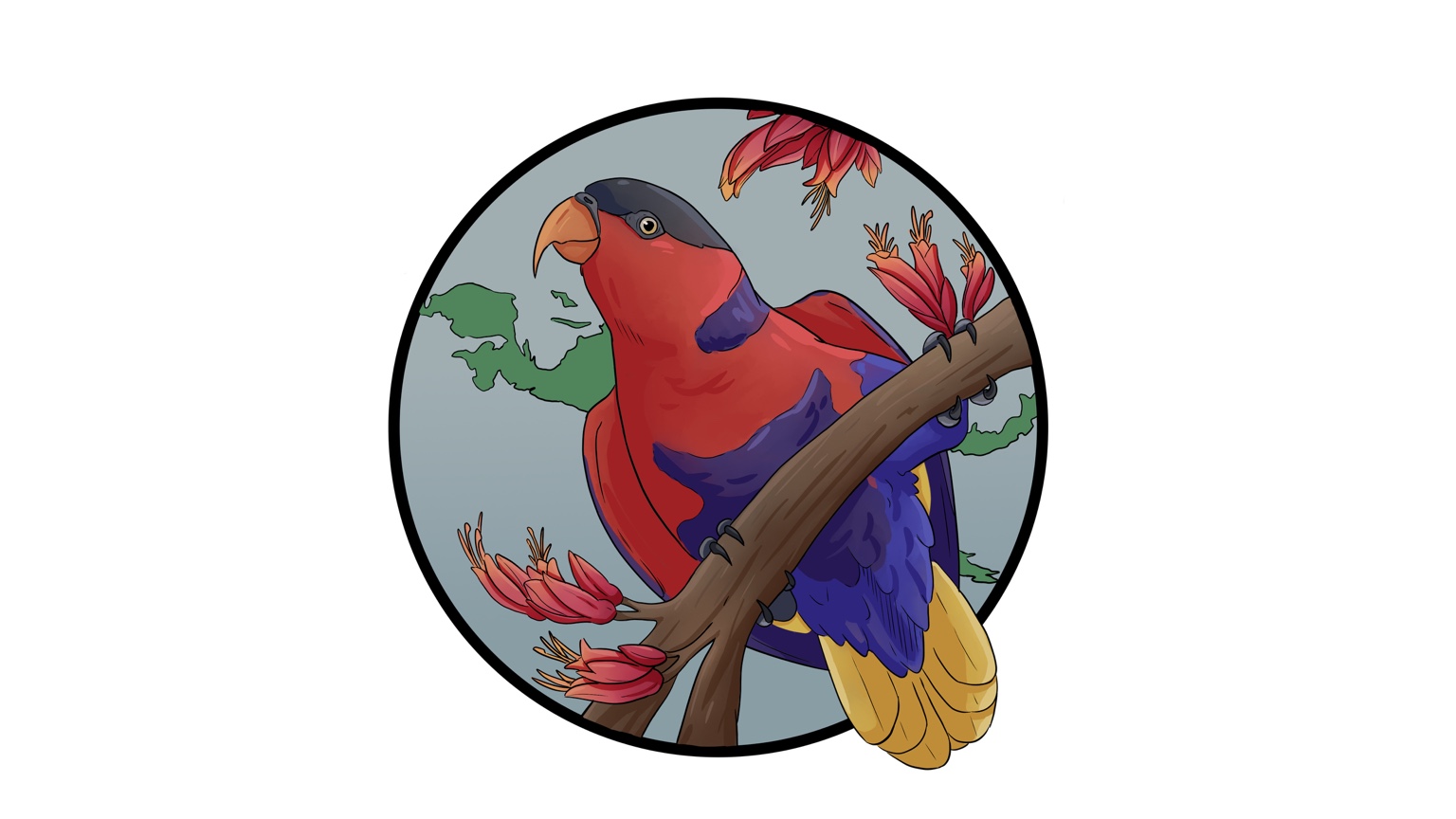
Black-capped Lory
Lorius lory (Linnaeus, 1758) · Psittaculidae
English, Simplified Chinese, Traditional Chinese, Hindi and Korean working names.
Names & taxonomy
Each working species page records its names, verification status and classification, and links to independent references so visitors can check them. Names are reviewed by hand. Nothing on this site updates automatically from these sources.
Experimental / Work in Progress
Our first working species reference connects multilingual names, historical combinations and independent resources. The supplied Chinese, Hindi and Korean translations have been verified by undergraduate native speakers. Taxonomic and regional-usage review remains separate; this is the template for future species.
Research taken on and led by James Guo, with contributions from undergraduate researchers. James established the initial approach to identifying and interpreting multilingual species names, particularly Chinese nomenclature in Simplified and Traditional Chinese. Other undergraduate students subsequently expanded the work to Hindi and Korean. He is not credited with translating or verifying all languages. Read Parrots by Many Names, our featured student research →
Entry type and verification status are recorded separately. An unsuccessful search does not prove that no established name exists. Each entry preserves its original script, language, source, student contributor where known, and verification status. Entry-level attribution remains unknown until confirmed.
Native speakers and regional experts can help identify established names outside the literature currently available to us. Please share the language, region and source, respecting community preferences about attribution and publication. Contribute a name or correction.
Featured reference
Lorius lory (Linnaeus, 1758) · Psittaculidae
English, Simplified Chinese, Traditional Chinese, Hindi and Korean working names.
Primary framework: Cornell/Clements and eBird. Proposed baseline: v2025; direct checklist verification and its release date are pending. Working record updated 12 November 2026. This is not a completed checklist review.
Project species IDs remain stable when names change. Historical citations retain their original names. When authorities disagree on names or species boundaries, we record each treatment with its source, checklist version and date rather than silently overwriting it. Links to library records are added only after review.
These links point to the original pages. We don’t copy text or images from these sources.
Older records and citations keep the names exactly as published. Published species entries connect current and historical names for searching; linking historical literature records remains work in progress.
Uncertain name matches and differences in species limits (splits and lumps) between the checklist, Avibase, the IUCN and historical sources are flagged here rather than resolved silently.
Know your sources
These resources complement one another. Start with names and classification, follow species research, check conservation assessments, or explore observations. A matching name does not mean every source uses the same species boundaries.
A bird database hosted by Birds Canada that brings together scientific names, synonyms, names in many languages, and comparisons among taxonomic checklists. Use it to trace names and compare species treatments. Avibase concept identifiers are separate from ITIS TSNs.
Source / publisher: Avibase / Birds Canada
A taxonomic database covering animals, plants, fungi, and other organisms. Use its scientific-name records to check classification, synonyms, and taxonomic standing. Each record has a Taxonomic Serial Number (TSN), which identifies an ITIS record and is not an Avibase identifier.
Source / publisher: Integrated Taxonomic Information System partnership
A global assessment of species’ extinction risk, published by the International Union for Conservation of Nature (IUCN). Use species assessments to understand conservation categories, population trends, threats, and conservation actions. Check the assessment date; a Red List category is not a measure of an individual bird’s health or care needs.
Source / publisher: International Union for Conservation of Nature (IUCN)
The Cornell Lab of Ornithology’s reference collection of detailed bird species accounts, bringing together research on identification, distribution, ecology, behavior, breeding, and conservation with citations. Use it for in-depth, source-backed species research. Full account access generally requires a subscription or institutional access.
Source / publisher: Cornell Lab of Ornithology
A Cornell Lab of Ornithology community-science platform where birders submit checklists of birds they observe. Use it to explore sightings, maps, seasonal patterns, and local birding hotspots, or contribute observations. Records are reviewed through automated checks and regional reviewers; observation coverage varies by place and effort.
Source / publisher: Cornell Lab of Ornithology
Ongoing research · Provisional excerpt
This selected excerpt contains 9 source rows: the six Lorius entries and three examples explicitly marked as Korean direct translations. It is not a complete import of the supplied table or an accepted species checklist. Scientific names are retained as supplied, pending taxonomic review.
ITIS and Avibase are linked separately. Each supplied numeric identifier is labeled as an ITIS Taxonomic Serial Number (TSN) and links to its ITIS report. Avibase links open the supplied species account or a scientific-name search where an exact account has not been confirmed. These systems use different identifiers and may follow different taxonomic treatments; all nine supplied TSNs in this excerpt were matched to their scientific names in ITIS on 12 November 2026.
The supplied Chinese, Hindi and Korean names are native-speaker translations verified by undergraduate students, as confirmed by the project owner. Verification of a translation does not by itself establish regional common-name usage. English names and scientific-name treatments retain their existing review status.
Lorius albidinucha
ITIS TSN 177438 ↗ Search Avibase ↗
Scientific-name search; matching account not yet verified
Look up additional names on Avibase: French · German · Portuguese · Spanish. These links open the source; names for this species have not yet been transcribed.
Source: supplied working table. Student contributor and region: not yet recorded for these entries.
Scientific-name variations as supplied: Domicella albidinucha, Lorius albidinucha, Lorius albidinuchus. These may include original combinations, subspecies, spelling variants or errors; equivalence has not been verified.
Lorius chlorocercus
ITIS TSN 554815 ↗ Search Avibase ↗
Scientific-name search; matching account not yet verified
Look up additional names on Avibase: French · German · Portuguese · Spanish. These links open the source; names for this species have not yet been transcribed.
Source: supplied working table. Student contributor and region: not yet recorded for these entries.
Scientific-name variations as supplied: Domicella chlorocercus, Lorius chlorocercus. These may include original combinations, subspecies, spelling variants or errors; equivalence has not been verified.
Lorius garrulus
ITIS TSN 177442 ↗ Search Avibase ↗
Scientific-name search; matching account not yet verified
Look up additional names on Avibase: French · German · Portuguese · Spanish. These links open the source; names for this species have not yet been transcribed.
Source: supplied working table. Student contributor and region: not yet recorded for these entries.
Scientific-name variations as supplied: Domicella garrula, Lorius garrulus, Lorius garrulus garrulus, Psittacus garrulus, Psittacus molluccensis. These may include original combinations, subspecies, spelling variants or errors; equivalence has not been verified.
Lorius domicella
ITIS TSN 554813 ↗ Search Avibase ↗
Scientific-name search; matching account not yet verified
Look up additional names on Avibase: French · German · Portuguese · Spanish. These links open the source; names for this species have not yet been transcribed.
Source: supplied working table. Student contributor and region: not yet recorded for these entries.
Scientific-name variations as supplied: Domicella domicella, Lorius domicella, Lorius domicellus, Psittacus Domicella. These may include original combinations, subspecies, spelling variants or errors; equivalence has not been verified.
Lorius hypoinochrous
ITIS TSN 177443 ↗ Search Avibase ↗
Scientific-name search; matching account not yet verified
Look up additional names on Avibase: French · German · Portuguese · Spanish. These links open the source; names for this species have not yet been transcribed.
Source: supplied working table. Student contributor and region: not yet recorded for these entries.
Scientific-name variations as supplied: Domicella hypoinochroa, Lorius amabilis, Lorius hypoinochrous, Lorius hypoinochrous hypoinochrous. These may include original combinations, subspecies, spelling variants or errors; equivalence has not been verified.
Lorius lory
ITIS TSN 177444 ↗ Avibase species account ↗
Species account supplied by the project owner
Source: Avibase. Avibase list supplied by the project owner, 12 November 2026. Labels and spellings retained as supplied.
Regional and checklist labels are preserved. These Avibase entries are separate from the student-verified translations. Scientific combinations are labeled separately from common names.
Look up additional names on Avibase: French · German · Portuguese · Spanish. The supplied Avibase names are included above.
Source: supplied working table. Student contributor and region: not yet recorded for these entries.
Scientific-name variations as supplied: Domicella lory, Lorius lory, Lorius lory lory, Psittacus Lory. These may include original combinations, subspecies, spelling variants or errors; equivalence has not been verified.
Chalcopsitta duivenbodei
ITIS TSN 177415 ↗ Search Avibase ↗
Scientific-name search; matching account not yet verified
Look up additional names on Avibase: French · German · Portuguese · Spanish. These links open the source; names for this species have not yet been transcribed.
Source: supplied working table. Student contributor and region: not yet recorded for these entries.
Charmosyna palmarum
ITIS TSN 554818 ↗ Search Avibase ↗
Scientific-name search; matching account not yet verified
Look up additional names on Avibase: French · German · Portuguese · Spanish. These links open the source; names for this species have not yet been transcribed.
Source: supplied working table. Student contributor and region: not yet recorded for these entries.
Charmosyna rubrigularis
ITIS TSN 554819 ↗ Search Avibase ↗
Scientific-name search; matching account not yet verified
Look up additional names on Avibase: French · German · Portuguese · Spanish. These links open the source; names for this species have not yet been transcribed.
Source: supplied working table. Student contributor and region: not yet recorded for these entries.
Source: Project-owner supplied working table, “Table 1. Detection of supplementary foodstuffs consumption among Psittaciformes genera.” Chinese, Hindi and Korean translations verified by undergraduate native speakers, as confirmed by the project owner on 12 November 2026. Individual student attribution not supplied. Project leadership is credited to James Guo; individual entry attribution is not inferred from that leadership.
The original table also mixes genus-level diet indicators, incomplete references, duplicate taxonomic treatments, truncated fields and extinction annotations. These are not imported as verified species-level diet or conservation claims. Elsewhere in the table, Palm and Red-chinned Lorikeets also appear under Vini; those alternate treatments remain unresolved rather than counted as additional species here.
About the student research · Contribute a correction, local name or original source